

Dimensional lumber is defined as wood that has been milled to standard or specific sizes. This seemingly straightforward definition is, however, complicated by the fact that the names we give common dimensional lumber pieces don't match their actual dimensions.
Whether you're a homeowner sourcing material for a renovation, a designer specifying finishes for a commercial project, or a builder seeking high-quality reclaimed stock, understanding dimensional lumber is the first step to finding the right wood. Longleaf Lumber mills and sells reclaimed dimensional lumber in a variety of species — here's everything you need to know.
Nominal - vs - Actual:
Most dimensional lumber has been planed smooth and has a nominal (named) size that specifically correlates to an actual, physical size with smaller dimensions. These dimensions are measured in inches in the United States and are stated as a set of numbers: thickness and width. The length of a board is considered separately, and is always an actual measurement. Planer Maintenance at Our Mill
Planer Maintenance at Our Mill
 Reclaimed Chestnut
 Reclaimed Maple
 Reclaimed Oak
 Reclaimed Heart Pine
Does Longleaf Lumber provide dimensional lumber?
Longleaf mills and sells reclaimed dimensional lumber in a variety of sizes and species. The measurements of our lumber can match those of any other lumberyard. However, we often mill to specific widths that are slightly different from conventional lumber to maximize the yield for this rare material. All lumber is dried in our kilns and can be ordered as rough-sawn lumber or surfaced, on any number of sides.
 Non-Reclaimed Oak
Longleaf operates as both mill and retailer from our Cambridge, MA and Berwick, ME locations. This dual role means we can custom-mill reclaimed dimensional lumber to exact specifications — a significant advantage for projects requiring non-standard dimensions or uncommon species. Contact our team to discuss your project's requirements.
Conventional lumber used in a structural capacity is typically graded to allow designers and builders to predictably and safely build structures. Reclaimed wood is rarely graded for structural use, even in cases where the material is of a size and species adequate for safe construction. For this reason, the dimensional lumber stock provided by reclaimed wood lumber mills is most often used as decorative elements or as cover for other structural elements that comply with building code.
Although the bulk of dimensional lumber is unseen and used for structural framing in residential and commercial construction, it is also frequently used for woodworking projects where the lumber will be on display. Common decorative applications for reclaimed dimensional lumber from Longleaf include: cabinetry, custom countertops and desk surfaces, stair treads, trim work, open shelving, box beam cladding, wainscoting and wall paneling, and furniture components. If you can see it, reclaimed dimensional lumber can make it extraordinary.
What kinds of projects utilize dimensional lumber?
Contemporary uses are most likely behind-the-scenes building construction elements such as studs, joists, and rafters. Plywood and other sheet goods are not considered dimensional lumber. Non-Structural Heart Pine Box Beams
Conventional lumber used in a structural capacity is typically graded to allow designers and builders to predictably and safely build structures. Reclaimed wood is rarely graded for structural use, even in cases where the material is of a size and species adequate for safe construction. For this reason, the dimensional lumber stock provided by reclaimed wood lumber mills is most often used as decorative elements or as cover for other structural elements that comply with building code.
Although the bulk of dimensional lumber is unseen and used for structural framing in residential and commercial construction, it is also frequently used for woodworking projects where the lumber will be on display. Common decorative applications for reclaimed dimensional lumber from Longleaf include: cabinetry, custom countertops and desk surfaces, stair treads, trim work, open shelving, box beam cladding, wainscoting and wall paneling, and furniture components. If you can see it, reclaimed dimensional lumber can make it extraordinary.
 Oak Desk
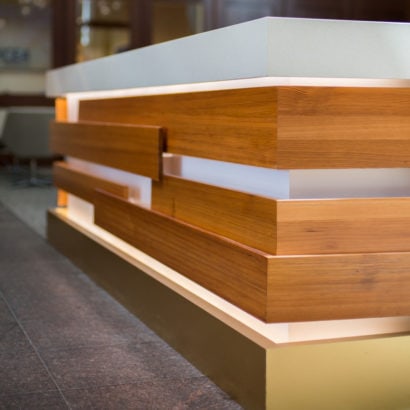 Heart Pine Millwork
 Maple Counter Top
 Hickory Treads
 Old Sturbridge Village Sawmill
Early 1800s Design Reproduction
Old Sturbridge Village Sawmill
Early 1800s Design Reproduction
The shift to balloon framing for residential and commercial structures further added to demand. This building method required smaller, more numerous, and consistent pieces of lumber. Running parallel to demand was the mass production and distribution of lumber, made possible by mechanized sawmills and the growing railroad system. As timber resources in the northeastern United States were exhausted, large-scale logging operations moved to the Great Lakes region and later to the Pacific Northwest. Distances grew between the mill and the construction site.
Freight for most lumber orders was paid by the customer, who naturally gravitated towards lumber that was already dry and planed, two factors that directly reduced weight and thus their freight charges. Lumber sticks that were uniform in size could also be more efficiently packaged for transport, further reducing costs.
The shift in planing location, to the lumber mills and away from the job site, was normalized by the late 1800s when separate planing mills were firmly a part of the milling process. In later years, larger mills incorporated planing as part of their vertical manufacturing structure.
Lumber retailers required uniform dimensions so purchasers could compare costs. Architects and builders required the same so they could design and build the booming number of projects in a predictable, safe, and cost-effective way. In response, standardized dimensions for lumber evolved, although they were defined regionally and varied by species for many years. It was not until 1924 that national standards were established. These standards underwent several iterations over the next four decades until the final and current version was solidified in 1969.
Freight for most lumber orders was paid by the customer, who naturally gravitated towards lumber that was already dry and planed, two factors that directly reduced weight and thus their freight charges. Lumber sticks that were uniform in size could also be more efficiently packaged for transport, further reducing costs.
 1884 Egan Planer
The shift in planing location, to the lumber mills and away from the job site, was normalized by the late 1800s when separate planing mills were firmly a part of the milling process. In later years, larger mills incorporated planing as part of their vertical manufacturing structure.
Lumber retailers required uniform dimensions so purchasers could compare costs. Architects and builders required the same so they could design and build the booming number of projects in a predictable, safe, and cost-effective way. In response, standardized dimensions for lumber evolved, although they were defined regionally and varied by species for many years. It was not until 1924 that national standards were established. These standards underwent several iterations over the next four decades until the final and current version was solidified in 1969.